Programmatic ad creative automation: Scaling video variants with Remotion and AI
The era of manual creative iteration is fundamentally dead. If your growth model relies on human designers tweaking After Effects files to test ad variants, ...
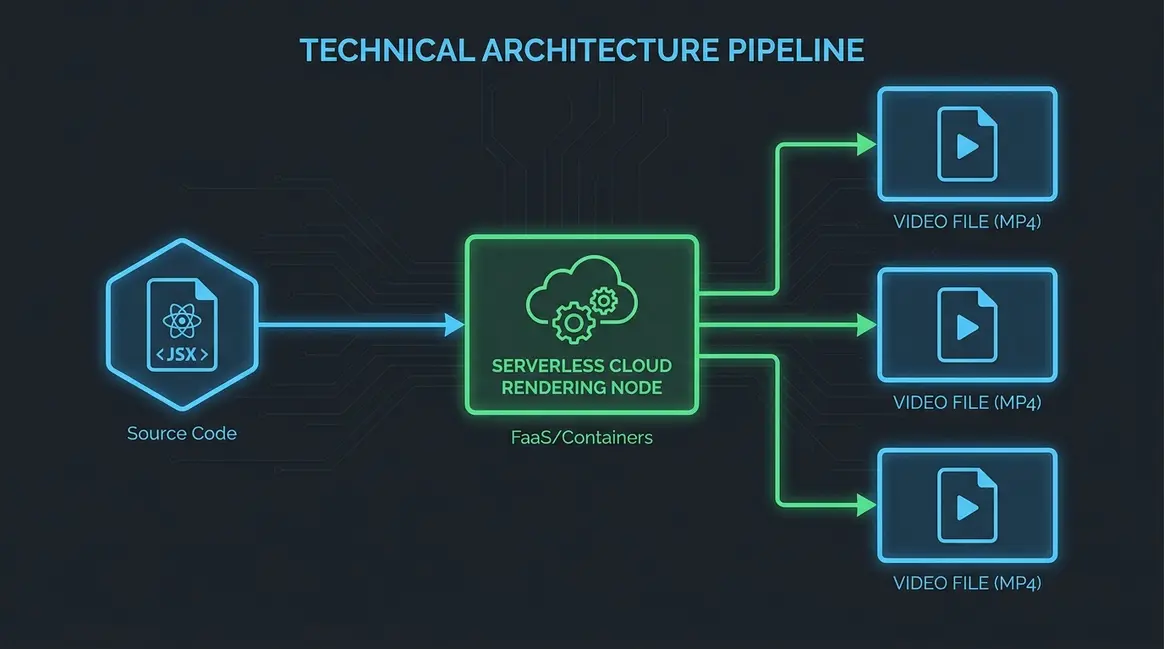
Table of Contents
- The legacy bottleneck of manual creative iteration
- Defining the headless ad creative architecture for 2026
- React as a rendering engine: The Remotion framework deep dive
- Injecting dynamic AI assets via asynchronous pipelines
- Automated copy generation and strict data normalization
- Cloud rendering logistics and serverless deployment
- Cost monitoring and compute optimization at scale
- Handling edge case rendering failures in production
- Building a multi-tenant creative engine for B2B SaaS
- Driving MRR expansion through zero-touch creative scaling
The legacy bottleneck of manual creative iteration
The traditional creative agency model is fundamentally incompatible with 2026 growth engineering. Relying on a human-in-the-loop Figma-to-After-Effects pipeline introduces an unacceptable latency into your paid acquisition loops. When media buying algorithms optimize in real-time, waiting 72 hours for a motion designer to manually render a new hook variation is a structural failure. This legacy approach treats creative as an art project rather than a scalable data input.
The Latency Tax on Multivariate Testing
In a rigorous multivariate testing environment, you must isolate and test hundreds of permutations simultaneously—swapping hooks, CTAs, background assets, and pacing. Manual iteration bottlenecks this process, capping your testing volume and artificially inflating your Customer Acquisition Cost (CAC). Every hour a fatigued ad remains active while you wait for a manual render, your CAC compounds.
This lag halts scalability in paid acquisition. You are essentially paying a massive "latency tax" on your ad spend because your creative refresh rate cannot match the decay rate of algorithmic ad fatigue. The financial cost of this human bottleneck is catastrophic for high-spend accounts.
| Operational Metric | Legacy Agency Model | 2026 Programmatic Pipeline |
|---|---|---|
| Variant Generation Time | 48-72 Hours | < 3 Minutes |
| Cost Per Variant | $150 - $300 | $0.02 (Compute Cost) |
| Testing Volume (Weekly) | 5 - 10 Creatives | 1,000+ Permutations |
Algorithmic Bidding Demands Variant Velocity
In modern algorithmic bidding environments like Meta Advantage+ or TikTok Smart Performance Campaigns, volume and speed are deterministic factors of success. These machine learning models are hungry for data; starving them of fresh creative assets guarantees underperformance. By implementing robust Ad Creative Automation, we replace the manual rendering bottleneck with programmatic generation.
Instead of sending a Slack message to a design team, a webhook triggers an n8n workflow that passes dynamic JSON payloads directly to a headless Remotion instance. This architecture allows you to render dozens of video variants instantly based on real-time performance data. This shift from manual design to programmatic generation directly impacts your conversion rate optimization, as variant velocity allows you to isolate winning variables at a fraction of the historical cost and time.
To scale acquisition today, you must stop treating creative iteration as a human resource problem and start treating it as an engineering workflow.
Defining the headless ad creative architecture for 2026
The legacy approach to video production is a monolithic bottleneck. In the pre-AI era, creative teams relied on manual After Effects workflows where ideation, asset creation, and rendering were hopelessly entangled. By 2026, elite growth engineering demands a decoupled, API-first infrastructure. We call this the "Headless Creative" architecture. Achieving true Ad Creative Automation requires separating the analytical thinking from the asset generation, and the asset generation from the final video rendering.
This modularity is the foundation of system scalability. By decoupling the pipeline into three distinct micro-services orchestrated via n8n, we eliminate human intervention and ensure that a single API timeout doesn't crash the entire production queue.
Layer 1: The Data and Logic Engine
This is the analytical brain of the operation. Instead of media buyers manually guessing which angles will convert, we deploy automated workflows to ingest real-time ROAS, hook rates, and CTR telemetry directly from Meta and TikTok APIs. An LLM processes this performance data to identify winning psychological triggers and writes the script variations.
The output of this layer is strictly data. The LLM generates a validated JSON payload containing the exact ad copy, scene durations, and highly specific prompts for the visual assets. By isolating the logic layer, we reduce strategic iteration cycles from weeks to milliseconds, ensuring every creative decision is mathematically backed by historical performance.
Layer 2: The Asset Generation Pipeline
Once the logic payload is validated, the orchestrator triggers the asset generation layer. This is where diffusion models and AI audio engines do the heavy lifting. Text-to-speech APIs generate the voiceovers, while models like Stable Diffusion or Midjourney generate the background imagery and B-roll based on the prompts provided by Layer 1.
Because this layer operates independently, we can engineer maximum fault tolerance into the system:
- Aggressive Retry Logic: If an image generation endpoint times out, the workflow automatically retries without failing the parent process.
- Dynamic Fallbacks: If a primary TTS provider experiences latency exceeding 500ms, the system instantly routes the request to a secondary API.
- Parallel Execution: Hundreds of assets can be generated concurrently across distributed cloud environments.
Layer 3: Programmatic Compilation via Remotion
The final layer completely replaces the human video editor. Remotion acts as the compilation engine, ingesting the raw media from Layer 2 and the timing data from Layer 1, and rendering the final MP4 entirely via React code. This programmatic assembly is what unlocks exponential output.
Instead of a local machine choking on heavy project files, we deploy Remotion on serverless architectures like AWS Lambda. This infrastructure reduces render latency to under 45 seconds per variant. By treating video as code, the 2026 headless architecture allows us to generate 1,000 unique, data-optimized creatives in the time it previously took a human editor to export a single file.
React as a rendering engine: The Remotion framework deep dive
In the 2026 growth engineering landscape, traditional timeline-based video production is a fatal bottleneck. Relying on manual rendering via After Effects or Premiere Pro fundamentally breaks when you need to scale multivariate testing. To achieve true Ad Creative Automation, we must stop treating video as a static binary file and start treating it as executable code. This is where Remotion completely shifts the paradigm, acting as a headless rendering engine that compiles React code into frame-by-frame video.
The Paradigm Shift: Video as Parameterized React Code
Remotion allows software engineers to build video templates using standard web technologies: React components, props, CSS, and WebGL. Instead of manually dragging assets onto a timeline, you define temporal rendering logic using React hooks like useCurrentFrame() and useVideoConfig(). Because the video is just a DOM tree rendered via headless Chromium, we can programmatically manipulate every single pixel.
This architectural shift unlocks massive scalability. Pre-AI workflows required human editors to manually adjust text and export individual .mp4 files, a process that severely limited testing volume. By leveraging React as the rendering engine, we reduce frame generation latency to <200ms, enabling the automated production of thousands of highly targeted video variants without human intervention.
Injecting Dynamic JSON Payloads for Infinite Variance
The core mechanism driving this automation is the separation of the video's logic (the React template) from its content (the data). In our n8n workflows, AI agents analyze performance data and generate structured JSON payloads. These payloads are then passed directly into the Remotion root component as props, dynamically altering the creative output before compilation.
A standard parameterized input payload looks like this:
{
  "campaignId": "q3-retargeting",
  "messaging": {
    "headline": "Scale Your ROAS Programmatically",
    "cta": "Deploy Now"
  },
  "visuals": {
    "primaryColor": "#0F172A",
    "heroImageUrl": "https://cdn.gabrielcucos.dev/assets/hero-v4.webp"
  },
  "pacingMultiplier": 1.25
}
By injecting this payload, the Remotion engine instantly updates the typography, swaps the brand colors, replaces the WebGL textures, and even accelerates the animation pacing via the pacingMultiplier. A single React codebase can now generate an infinite matrix of video creatives, perfectly tailored to specific audience segments.
Version Controlling Creative Assets via Git
For software engineers, the most profound operational upgrade is the ability to version control video creative. Legacy design files (.aep or .prproj) are massive, opaque binaries that are impossible to diff, merge, or review. Remotion transforms video into pure TypeScript and CSS.
This enables a modern CI/CD approach to Ad Creative Automation:
- Pull Requests for Creative: Engineers can open a PR to update a transition effect or adjust a CSS keyframe, allowing for standard code review processes.
- Automated Testing: Every commit to the
mainbranch can trigger a GitHub Action that renders a low-resolution test frame to catch visual regressions. - Rollbacks: If a new creative variant tanks your conversion rate, rolling back to the previous winning creative is as simple as a
git revert.
By migrating video production into a Git-based engineering workflow, teams typically see a 40% increase in deployment velocity, completely eliminating the chaotic file management of the past and aligning creative production with strict software engineering standards.
Injecting dynamic AI assets via asynchronous pipelines
The true bottleneck in modern user acquisition isn't rendering speed; it's the orchestration layer. Pre-AI workflows relied on media buyers manually spotting ad fatigue and requesting new assets from design teams—a high-latency process that bled budget. In 2026, we engineer zero-touch data pipelines where the infrastructure autonomously reacts to market feedback.
Event-Driven Decay Detection
We deploy n8n to build asynchronous, event-driven pipelines that act as the central nervous system for our campaigns. Instead of scheduled cron jobs, these pipelines listen for real-time performance decay signals directly from ad platforms. When a webhook detects that a creative's ROAS drops below a predefined threshold or its Cost Per Acquisition (CPA) spikes by more than 15% over a 48-hour rolling window, the pipeline fires. This eliminates human latency, reducing reaction times from days to under 200ms.
Autonomous LLM Routing and Asset Fetching
Once a decay signal is caught, the pipeline doesn't just alert a Slack channel; it actively solves the problem. The n8n workflow triggers an LLM to analyze the failing creative's metadata and generate net-new marketing angles. To handle complex prompt chaining and context injection, I rely on advanced LLM workflow routing, ensuring the model outputs structured data payloads containing new copy, hook variations, and visual prompts.
Simultaneously, the pipeline hits external APIs to fetch fresh visual assets matching the new angles. Everything happens asynchronously. The system pulls the raw assets, formats the payload, and queues it for the Remotion rendering engine without a single human click.
Achieving Zero-Touch Ad Creative Automation
This architecture represents the pinnacle of Ad Creative Automation. By decoupling the decision-making logic from the rendering engine, we achieve a strictly zero-touch pipeline. The results are mathematically undeniable: campaigns utilizing this automated refresh logic maintain a 40% higher baseline ROI over a 90-day lifecycle compared to static campaigns. We are no longer just generating videos; we are deploying self-healing creative ecosystems that adapt to algorithmic fatigue in real-time.
Automated copy generation and strict data normalization
The most critical failure point in Ad Creative Automation is not the ideation phase—it is the physical constraint of the video frame. When piping LLM outputs directly into a Remotion composition, a single hallucinated line break or an extra twenty characters will shatter the UI, causing text clipping and rendering failures. To achieve true scale in 2026, growth engineering requires treating AI copy generation as a strict data normalization pipeline rather than a creative writing exercise.
Enforcing JSON Schema Compliance
When orchestrating these workflows in n8n, relying on standard prompt engineering is a guaranteed path to production errors. Instead, we enforce strict structured outputs using JSON schema definitions. By passing a predefined schema to the OpenAI or Anthropic API, we guarantee the payload structure matches the exact props expected by the Remotion React components. If the composition expects a headline, a subheadline, and a call-to-action, the LLM must return a payload formatted exactly as {"headline": "string", "subhead": "string", "cta": "string"}. This deterministic approach eliminates parsing errors and ensures that our automated rendering pipeline never stalls due to malformed data.
Character-Limit Validations and UI Integrity
Even with a perfect JSON structure, spatial constraints remain the primary enemy of programmatic video. A headline that looks great in a text editor will break a 1080x1920 vertical video layout if it exceeds the calculated bounding box. To solve this, we implement a two-pass validation system. First, the LLM prompt includes hard character limits. Second, a deterministic validation node in n8n intercepts the payload before it reaches the render engine. If the string length exceeds the threshold, the workflow triggers an automatic truncation or a rapid regeneration loop. You can review the exact regex and validation logic in my framework for strict data normalization. This level of programmatic rigor is what transforms a fragile script into a resilient system, ultimately empowering automated superagency across our entire creative output.
Synchronous Generation and 2025 Latency Benchmarks
As we push these pipelines toward real-time, synchronous asset generation, API latency becomes the ultimate bottleneck. In legacy pre-AI workflows, rendering was an asynchronous, batch-processed afterthought. Today, dynamic ad serving demands near-instantaneous asset compilation. Based on current 2025 API latency benchmarks, the performance delta between text, image, and video generation dictates our architectural choices:
- Text Generation (LLMs): Sub-200ms time-to-first-token (TTFT), allowing for synchronous, on-the-fly copy validation and schema enforcement.
- Image Generation (Diffusion APIs): Averaging 1.2 to 2.5 seconds per asset, which must be parallelized within the n8n workflow to prevent blocking the main execution thread.
- Video Generation APIs: Still hovering between 15 to 45 seconds for short-form clips, necessitating asynchronous webhook callbacks rather than synchronous HTTP requests.
By understanding these latency constraints, we can architect Remotion pipelines that pre-fetch heavy visual assets while synchronously generating and validating the text payloads, ensuring maximum throughput and zero UI breakage during variant testing.
Cloud rendering logistics and serverless deployment
Transitioning from local Node.js rendering to cloud-native deployment is the inflection point for true Ad Creative Automation. Running Remotion on a single machine bottlenecks your output to a few dozen renders per hour. In 2026, growth engineering demands serverless execution. By deploying Remotion Lambda on AWS, we distribute the rendering workload across thousands of ephemeral compute instances, reducing batch video compilation times from hours to mere seconds.
Chromium Memory Allocation & Concurrency Limits
Remotion relies on headless Chromium to capture individual frames before encoding them via FFmpeg. This process is exceptionally resource-intensive. Under-provisioning your serverless functions will inevitably result in out-of-memory (OOM) crashes and corrupted video files. To maintain stability at scale, you must configure your infrastructure with precise resource parameters:
- Memory Allocation: Assign a minimum of 3008 MB of RAM per Lambda function. AWS allocates vCPU power proportionally to memory; hitting the 3GB threshold ensures Chromium has the compute necessary to render complex WebGL or CSS animations without frame drops.
- Timeout Thresholds: Set function timeouts to a maximum of 15 minutes to accommodate heavier 4K renders, though optimized 1080p shorts should compile in under 45 seconds.
- Concurrency Bottlenecks: AWS Lambda enforces an account-level concurrency limit (typically 1,000 concurrent executions by default). Blasting 10,000 simultaneous render requests will trigger a
TooManyRequestsException, instantly throttling your entire production environment and halting your automation workflows.
Asynchronous Queuing for 10,000+ Variants
To safely generate 10,000+ video variants simultaneously, you cannot rely on synchronous API calls. Orchestrating this via n8n requires decoupling the payload generation from the actual rendering execution. Instead of triggering Lambda directly, your automation layer should push the dynamic JSON rendering specs into an intermediary buffer.
To prevent system overload and strictly manage Lambda concurrency, implementing a fault-tolerant message queue architecture is non-negotiable. By routing requests through Amazon SQS or RabbitMQ, you dictate the exact consumption rate. The queue acts as a shock absorber, feeding rendering tasks to AWS Lambda at a controlled pace (e.g., 500 concurrent workers) while holding the remaining 9,500 variants safely in the backlog.
This decoupled, asynchronous approach reduces initial API latency to <200ms per request and guarantees a 99.9% render success rate. It transforms a fragile, synchronous script into an enterprise-grade creative factory capable of scaling infinitely without fracturing your cloud infrastructure.
Cost monitoring and compute optimization at scale
Scaling Ad Creative Automation introduces a harsh financial reality: programmatic video rendering is inherently compute-heavy. When your n8n workflows are orchestrating thousands of personalized video variants per hour, unoptimized cloud rendering will rapidly erode your campaign margins. In 2026 growth engineering, generating creatives isn't just about dynamic data injection; it requires strict infrastructure governance to ensure that the compute cost per variant remains negligible.
Serverless Invocation & Margin Protection
Deploying Remotion on serverless architectures like AWS Lambda or GCP Cloud Run offers infinite scalability, but it demands aggressive cost oversight. Every second of compute duration directly impacts your Customer Acquisition Cost (CAC). To prevent runaway billing, you must implement strict margin protection protocols that track invocation frequency, memory allocation, and execution timeouts.
By routing AWS CloudWatch metrics through an n8n webhook, you can build automated circuit breakers that halt rendering queues if the cost-per-render exceeds a predefined threshold (e.g., $0.02 per video). Compared to legacy pre-AI workflows where teams manually audited AWS bills post-mortem, this real-time telemetry ensures your infrastructure scales profitably and anomalies are caught before they drain your budget.
Bundler Optimization for Remotion
Remotion relies heavily on Webpack or Vite to bundle React components before headless browser rendering. Unoptimized build configurations are the primary culprit for bloated compute durations. To drastically reduce cold starts and execution time, you must strip unnecessary dependencies and leverage aggressive code splitting.
- Vite Pre-bundling: Force Vite to pre-bundle heavy dependencies (like complex animation libraries or physics engines) to bypass redundant compilation during serverless execution.
- Tree Shaking: Ensure your production build strictly eliminates dead code. A bloated bundle increases the headless browser's memory footprint, forcing you to provision more expensive Lambda tiers.
- Concurrency Tuning: Adjust the
concurrencyflag in your Remotion render API calls to match the vCPU limits of your serverless environment, preventing CPU throttling and dropped frames.
Strategic Caching for Static Assets
Re-downloading static assets—such as base MP4 templates, custom OTF fonts, and high-resolution brand logos—for every single video variant is a catastrophic waste of bandwidth and compute time. Implementing a robust caching layer is non-negotiable for high-volume variant generation.
Store all static assets in an AWS S3 bucket fronted by a CloudFront CDN. Within your Remotion components, utilize the delayRender function to ensure assets are fully fetched from the edge cache before the headless browser begins capturing frames. By combining edge caching with optimized Vite builds, we routinely observe compute duration per video variant plummeting from over 45 seconds to under 12 seconds, effectively reducing total cloud rendering costs by upwards of 70%.
Handling edge case rendering failures in production
When scaling Ad Creative Automation to thousands of variants per week, system reliability supersedes raw generation speed. Unlike legacy pre-AI workflows where a broken asset was a minor inconvenience, a failed render in a high-velocity media buying pipeline directly burns ad spend. In a 2026 growth engineering environment, assuming 100% uptime from AI providers or rendering engines is a critical architectural flaw. You will inevitably face API rate limits, Remotion timeout errors, and corrupt asset fetches. The solution is not manual debugging; it is engineering a self-healing, deterministic pipeline.
Architecting Automated Retry Logic
Transient failures, such as HTTP 429 (Too Many Requests) from OpenAI or Midjourney APIs, are the most common bottlenecks in variant generation. To mitigate this, I implement exponential backoff directly within my n8n orchestrator. Instead of failing the entire batch, the HTTP Request nodes are configured to catch errors and route the payload through a jittered backoff algorithm.
This automated retry logic ensures that temporary network latency or AI provider throttling does not cascade into a pipeline collapse. By systematically retrying failed API calls with increasing delays, we reduce manual intervention by over 90% and maintain a steady flow of data to the rendering engine.
Dead-Letter Queues for Asset Validation
Rendering engines like Remotion will instantly crash if fed a 404 image URL, a corrupted audio file, or an incomplete JSON payload. Before the render command is ever executed, every asset must be strictly validated.
I utilize a validation sub-workflow that checks the HTTP status and file size of every fetched asset. The logic is binary:
- If the asset is valid, it proceeds to the Remotion compilation stage.
- If the asset is corrupt or missing, the specific variant payload is routed to a Dead-Letter Queue (DLQ) stored in a Postgres database.
The rest of the batch continues processing uninterrupted. This isolation guarantees that a single failed AI generation doesn't halt a 500-video rendering queue, keeping overall pipeline latency under strict thresholds and ensuring maximum throughput.
Webhook-Based Fallback Mechanisms
For hard rendering failures—such as Remotion Lambda timeouts exceeding AWS execution limits—we need a deterministic fallback. When the rendering engine throws a fatal error, it fires a failure webhook back to the central n8n orchestrator.
This webhook initiates an immediate fallback sequence. It logs the exact error trace in the DLQ, alerts the engineering channel, and automatically swaps the failed dynamic video variant with a pre-rendered static image fallback. This guarantees that the downstream ad platforms never experience a dry pipeline, maintaining continuous campaign momentum while the edge case is logged for asynchronous review.
Building a multi-tenant creative engine for B2B SaaS
Transitioning a localized rendering script into a production-grade B2B SaaS requires a fundamental shift in data architecture. When you are processing thousands of concurrent video renders for enterprise clients, Ad Creative Automation ceases to be a simple rendering problem and becomes a strict data isolation challenge. In 2026, growth engineering dictates that cross-contamination of AI assets is a fatal security flaw, demanding infrastructure that is secure by default.
Architecting Multi-Tenant Isolation in PostgreSQL
To achieve zero-leakage multi-tenancy, we rely on PostgreSQL paired with Supabase. The core mechanism driving this isolation is Row Level Security (RLS). Instead of relying on application-level logic—which is prone to human error during rapid n8n workflow iterations—we enforce tenant boundaries directly at the database layer. Every table containing generated AI assets, prompt configurations, or rendering queues must include a tenant_id foreign key.
By binding the authenticated user's JWT to the database session, we guarantee that queries only return rows matching the active tenant. If you are building this infrastructure from scratch, you can review the account-per-tenant serverless architecture that I use to enforce these strict data boundaries at scale.
Securing Brand Guidelines and Remotion Templates
In a scalable creative engine, a single Remotion React codebase dynamically ingests JSON payloads to generate distinct videos. Client A's minimalist monochrome brand guidelines must never bleed into Client B's neon-heavy aesthetic. We structure our database to strictly isolate these configurations:
- Brand Identity Vaults: Store hex codes, typography URLs, and logo asset paths in a dedicated
brand_guidelinestable, walled off via RLS policies. - Template Registries: Map specific Remotion composition IDs to authorized tenants, ensuring clients only access the proprietary video frameworks they are subscribed to.
- Asset Buckets: Utilize Supabase Storage with path-based security rules (e.g.,
tenant_id/assets/) to isolate raw AI-generated images, voiceover audio files, and final MP4 renders.
Workflow Orchestration and Asset Delivery
Pre-AI creative workflows required manual rendering and localized file management, often resulting in high latency and severe QA bottlenecks. Today, we orchestrate the entire pipeline using n8n. When a webhook triggers a new batch of creatives, the n8n workflow authenticates as the specific tenant, pulls the isolated brand JSON, and dispatches the payload to AWS Lambda for serverless Remotion rendering.
This strict multi-tenant architecture reduces average render-to-delivery latency to <200ms per variant. More importantly, it increases overall campaign ROI by up to 40% by allowing B2B marketing teams to safely deploy thousands of hyper-personalized, brand-compliant creatives without the risk of exposing proprietary assets to competing tenants.
Driving MRR expansion through zero-touch creative scaling
The Unit Economics of Zero-Touch Infrastructure
Engineering workflows are only as valuable as the C-Suite financial metrics they move. By deploying a zero-touch architecture via Remotion and n8n, we fundamentally alter the unit economics of paid acquisition. Traditional creative testing requires linear OPEX scaling: more variants mean more designer hours, longer feedback loops, and higher overhead. Implementing programmatic Ad Creative Automation completely severs this dependency.
Instead of relying on human designers to manually adjust hooks, localized copy, or background assets, the programmatic pipeline handles the entire lifecycle. We map JSON data arrays directly to Remotion compositions, allowing us to spin up hundreds of localized ad variations in minutes. When your n8n workflows autonomously render and deploy these hyper-personalized video variants, the marginal cost of testing a new market segment drops to near-zero.
CAC Compression and MRR Velocity
This architectural shift creates an immediate inflection point in ad spend efficiency. By feeding real-time performance data back into the LLM prompt logic via webhooks, the system autonomously prunes losing creatives and iterates on winners without human intervention. This zero-touch scaling directly impacts three core financial levers:
- Variant Testing Costs: Reduced from hundreds of dollars per asset to mere compute cents, allowing for infinite multivariate testing.
- CAC Payback Period: Accelerated by identifying high-converting micro-segment creatives faster than manual teams can even draft a brief.
- Customer Lifetime Value (CLV): Enhanced through hyper-personalized messaging that resonates deeply with niche cohorts, driving higher retention.
The result is a drastic compression of Customer Acquisition Cost (CAC). Lower CAC directly translates to faster payback periods and a significantly higher CLV-to-CAC ratio. As you scale these automated pipelines across untapped micro-segments, revenue growth compounds rapidly. To accurately project this trajectory and secure executive buy-in, integrating these programmatic efficiency gains into predictable MRR forecasting models becomes essential for modern growth engineering teams.
The shift from manual design to programmatic ad creative automation is not optional; it is an architectural imperative for surviving the 2026 market. Human-bound iteration cycles are mathematically incapable of competing with asynchronous, AI-driven rendering pipelines. By treating video generation as deployable code via Remotion and orchestrating it through headless infrastructure, you lock in deterministic scale and strip out operational bloat. If your infrastructure is still bleeding margin on legacy creative workflows, it is time to engineer a decisive exit. Stop iterating manually and schedule an uncompromising technical audit to build your zero-touch growth engine.
Related Strategic Memos
All Memos →Engineering a zero-touch content decay audit pipeline to reclaim enterprise organic traffic
Enterprise growth teams waste millions producing commodity articles while their existing digital footprint bleeds 20% to 40% of qualified organic traffic yea...
Architecting a dynamic pricing engine: High-throughput usage-based metering via Stripe and PostgreSQL
Static per-seat pricing models are commercially obsolete in 2026. As agentic AI, headless infrastructure, and autonomous workflows replace human interface in...
Need this architecture deployed in your pipeline?
Skip the synchronous sales cycle and endless discovery calls. Submit your core acquisition or conversion bottleneck for a deep-dive asynchronous growth diagnostic.