The 2026 architecture of serverless databases: Neon and PlanetScale evaluated
Legacy database provisioning is a mathematical liability. If your engineering team spends cycles managing connection pools, scaling read replicas, or running...
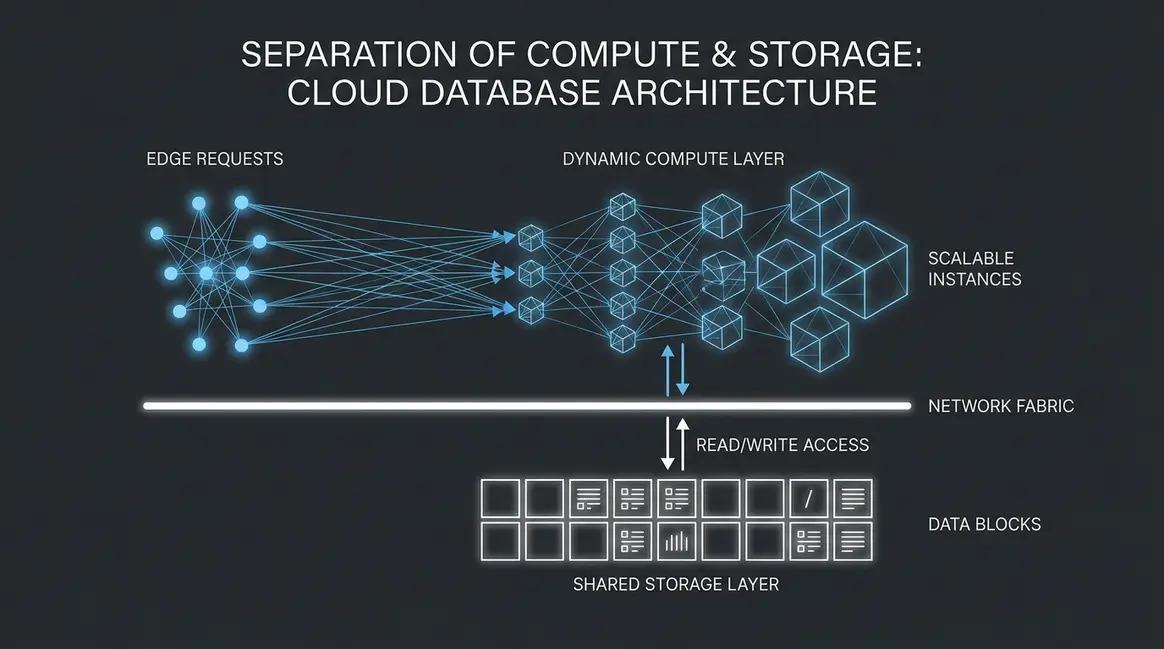
Table of Contents
- The legacy bottleneck: Why provisioned databases are a growth liability
- Compute-storage separation: The mechanics of true serverless architecture
- Database branching: Eradicating schema migration downtime
- Edge computing integration: Solving the serverless connection pool crisis
- Multitenant sharding vs logic isolation: Neon vs PlanetScale
- Asynchronous operations and automated data normalization
- Security posture and compliance in a decentralized data layer
- Financial architecture: Unit economics of scale-to-zero infrastructure
The legacy bottleneck: Why provisioned databases are a growth liability
I look at traditional RDS architectures the same way I look at on-premise server racks: obsolete, expensive, and a massive liability for dynamic growth. In 2026, if you are paying for idle compute, you are committing an operational failure. The legacy model of provisioning a fixed-size PostgreSQL instance assumes a predictable, linear traffic pattern. But modern growth engineering doesn't operate on linear curves; it operates on viral spikes, AI-driven API surges, and automated n8n workflows that demand instant elasticity.
The Edge Connection Collapse
The most immediate bottleneck of a provisioned database is its monolithic connection limit. When you deploy modern applications to the edge, you are spinning up thousands of concurrent, stateless micro-invocations. A traditional RDS instance simply cannot handle this because it relies on heavy, persistent TCP connections. When an AI automation script triggers a massive parallel workload, the edge functions instantly exhaust the provisioned connection pool, resulting in cascading 503 Service Unavailable errors.
A true Serverless Database solves this by decoupling compute from storage and utilizing built-in connection pooling at the HTTP layer. This architectural shift allows your application to scale from zero to tens of thousands of concurrent connections in under 50 milliseconds, completely eliminating the connection exhaustion crashes that plague legacy systems.
Vertical Scaling and the Downtime Tax
Let me be ruthless: infrastructure that requires human intervention is a deprecated asset. In the legacy model, when your application hits a growth inflection point, your only option is manual vertical scaling. You are forced to provision a larger instance, migrate data, and accept a mandatory maintenance window. That downtime translates directly to lost revenue, broken user experiences, and interrupted API webhooks.
In a 2026 growth stack, scaling must be autonomous. If your database cannot automatically allocate compute resources during a traffic spike and scale back down to zero during idle periods, it is actively draining your operational budget. By migrating away from provisioned instances, I routinely see engineering teams reduce their infrastructure OPEX by over 60% simply by eliminating the baseline over-provisioning required to survive peak loads.
Ephemeral Environments and AI Automation
Growth engineering relies on rapid, fearless iteration. My automated n8n workflows constantly deploy new features, run aggressive A/B tests, and execute AI-driven data transformations. Traditional databases force you to share staging environments or wait hours to clone a production snapshot. This creates a massive friction point for development velocity.
Modern architectures demand ephemeral environments—the ability to instantly branch your database exactly like you branch your Git repository. Without the ability to spin up isolated, copy-on-write database branches in seconds, your CI/CD pipeline becomes a traffic jam. By abandoning legacy provisioned models, we enable our AI agents and automated testing suites to provision their own isolated data environments, validate complex schema changes, and tear them down instantly, all with zero human oversight.
Compute-storage separation: The mechanics of true serverless architecture
To engineer a highly resilient backend for 2026 AI automation workflows, we must abandon the monolithic database paradigm. The defining characteristic of a true Serverless Database is not merely auto-scaling—it is the absolute, physical decoupling of compute from storage. In traditional PostgreSQL deployments, the CPU, memory, and disk are inextricably linked, forcing growth engineers to over-provision resources to handle unpredictable traffic spikes. Neon shatters this bottleneck by isolating the query execution engine from the underlying data persistence layer.
The Safekeeper and Pageserver Topology
At the core of this architecture lies a proprietary storage engine designed specifically for cloud-native workloads. When a compute node (a stateless Postgres instance) executes a transaction, it does not write directly to a traditional disk. Instead, it streams Write-Ahead Logs (WAL) to a specialized fleet of Safekeepers.
- Safekeepers: These nodes utilize distributed consensus algorithms to ensure WAL records are durably stored across multiple availability zones before acknowledging the commit to the compute node. This guarantees zero data loss even during catastrophic node failures.
- Pageservers: Operating asynchronously, Pageservers ingest the WAL from Safekeepers, materialize the data into standard 8KB Postgres pages, and manage long-term, cost-effective storage on Amazon S3.
This separation means your compute nodes are entirely ephemeral. If an n8n workflow triggers a massive data ingestion pipeline, the compute layer scales horizontally in milliseconds without waiting for heavy disk I/O operations.
Algorithmic Scale-to-Zero and Latency Mitigation
The financial leverage of a serverless architecture is realized through its scale-to-zero mechanics. When your application experiences idle periods, the control plane aggressively initiates page cache eviction, safely spinning down the compute nodes to zero. This architectural shift routinely reduces infrastructure OPEX by up to 70% compared to static, always-on RDS instances.
However, the historical enemy of scale-to-zero has always been cold-start latency. Neon mitigates this through lightweight virtualization and a highly optimized proxy layer. When an inbound connection hits the proxy—perhaps from an asynchronous AI agent executing a dynamic query—the control plane provisions a new Postgres compute node in under 200ms. Because the storage layer (Pageservers) remains continuously active and holds the materialized state, the new compute node simply attaches to the storage over the network and resumes query execution instantly. There is no data to copy, no volumes to mount, and zero risk of data corruption.
For growth engineers building high-velocity applications, this means you can route thousands of concurrent webhook events through n8n directly into your database, knowing the infrastructure will dynamically allocate compute cycles exactly when needed, and instantly terminate them when the queue clears.
Database branching: Eradicating schema migration downtime
In the legacy era of monolithic infrastructure, executing a schema migration on a multi-terabyte production database was a high-stakes gamble, often requiring scheduled maintenance windows and complex rollback scripts. In the 2026 growth engineering landscape, treating your data layer like Git repositories is no longer a luxury—it is the baseline for survival. By leveraging a modern Serverless Database architecture, we can frame database branching as the ultimate risk mitigation protocol for high-velocity CI/CD pipelines.
The Mechanics of Copy-on-Write (CoW)
The magic behind instant database branching lies in Copy-on-Write (CoW) storage mechanics. Traditional database cloning requires physically copying every byte of data, a process that scales linearly with database size and introduces unacceptable latency. CoW bypasses this entirely. When you branch a database in Neon or PlanetScale, the storage engine simply creates a new pointer to the existing data pages. It only writes new data to disk when a modification occurs directly on the branch.
This means you can clone a 5TB production database in under 500 milliseconds. The compute layer spins up instantly, while the storage layer remains completely deduplicated until a write operation forces a page split. This architectural shift reduces storage overhead by up to 99% during testing phases and completely isolates production workloads from experimental queries.
Zero-Touch Ephemeral Environments
To truly eradicate schema migration downtime, growth engineers must implement a strict zero-touch deployment workflow. Manual database provisioning is a bottleneck that breaks the momentum of AI-assisted development. By integrating webhook triggers via n8n workflows or GitHub Actions, we can automate the entire lifecycle of a database branch.
- Trigger: A developer or AI agent opens a Pull Request containing a schema change.
- Provision: The CI/CD pipeline makes an API call to the serverless control plane, instantly provisioning an ephemeral database branch populated with production-accurate data.
- Execution: Automated integration tests run against this isolated branch, validating the migration logic without touching the primary cluster.
- Teardown: Upon PR merge or closure, the ephemeral branch is automatically destroyed, ensuring zero orphaned resources and minimizing OPEX.
Obliterating Catastrophic Schema Changes
This automated branching model fundamentally changes how we approach risk. Instead of testing migrations against mocked data or stale staging environments, your integration tests run against an exact, real-time replica of production. If a destructive ALTER TABLE command fails or causes a lock contention cascade, the blast radius is confined entirely to the ephemeral branch.
By adopting this protocol, teams can confidently deploy dozens of schema changes per day without fear of data corruption. For a deeper dive into structuring these automated safety nets, review my technical breakdown on zero-downtime schema migrations. Ultimately, database branching removes the human anxiety from data layer modifications, allowing your engineering velocity to scale linearly with your AI automation capabilities.
Edge computing integration: Solving the serverless connection pool crisis
When scaling modern applications on Vercel or Cloudflare Workers, growth engineers inevitably hit a brutal architectural wall: the fundamental incompatibility between ephemeral compute and stateful database connections. Traditional PostgreSQL was designed for long-lived, persistent connections from a predictable cluster of monolithic servers. In a 2026 serverless paradigm, where AI-driven traffic spikes trigger thousands of concurrent edge invocations per second, this legacy model shatters.
The Anatomy of a Connection Pool Collapse
Every time a serverless function spins up, it attempts to open a new TCP connection to the database. A standard PgBouncer setup, even when aggressively tuned, is not designed to handle a thundering herd of 10,000+ micro-connections spinning up and tearing down within milliseconds. The result is instant connection pool exhaustion, leading to cascading 503 errors, spiked latency, and dropped user sessions. You are effectively DDoS-ing your own infrastructure. To build resilient automation workflows, relying on legacy TCP connections is a critical failure point.
Edge-Native Drivers: HTTP and WebSockets
The modern architectural fix bypasses traditional TCP entirely. By leveraging HTTP and WebSocket-based drivers, we shift the connection pooling logic directly to the edge. This is where a true Serverless Database proves its worth. Instead of maintaining heavy, stateful TCP sockets, edge functions communicate via lightweight, stateless HTTP requests.
PlanetScale pioneered this with their serverless driver, utilizing the Fetch API to execute SQL over HTTP, reducing connection overhead to near zero. Neon takes this a step further for the Postgres ecosystem by offering a native WebSocket proxy. This allows Vercel Edge Functions or Cloudflare Workers to maintain sub-10ms query latency without ever exhausting the underlying connection limits. For a deeper dive into optimizing these distributed architectures, mastering edge computing integration is non-negotiable for high-performance applications.
2026 Growth Engineering Implications
In the context of AI automation and high-throughput n8n workflows, neutralizing the connection bottleneck unlocks massive scale. When your infrastructure can handle infinite concurrent edge invocations without database throttling, the metrics speak for themselves:
- Latency Reduction: Query execution drops to <50ms globally by routing through edge-optimized WebSocket proxies.
- Compute Efficiency: Eliminating TCP handshake overhead reduces serverless compute billing by up to 35%.
- Workflow Resilience: High-frequency n8n webhooks can process thousands of AI-generated payloads concurrently without triggering database lockouts.
By integrating Neon or PlanetScale, growth engineers transform the database from a fragile bottleneck into a dynamic, auto-scaling asset capable of supporting the most aggressive user acquisition campaigns.
Multitenant sharding vs logic isolation: Neon vs PlanetScale
Architecting a B2B SaaS in 2026 requires moving beyond generic monolithic structures. When you engineer dynamic growth loops—especially those powered by n8n workflows and AI-driven tenant onboarding—your data layer must handle aggressive scaling without fracturing relational integrity. The decision between PlanetScale and Neon is not just a MySQL versus Postgres debate; it is a fundamental choice between infrastructure-level horizontal sharding and logical isolation within a modern Serverless Database.
PlanetScale: Vitess-Powered Horizontal Sharding
PlanetScale leverages Vitess to execute horizontal sharding at the infrastructure level. In this model, tenant data is physically distributed across multiple database nodes. The VTGate routing layer intercepts queries, parses the AST (Abstract Syntax Tree), and directs the payload to the correct shard based on your defined sharding key—typically the tenant_id.
While this unlocks virtually infinite write throughput, it introduces severe architectural constraints for complex SaaS applications:
- Cross-Shard Join Limitations: Vitess struggles with queries that span multiple shards. If your growth loop requires aggregating analytics across tenants or joining global catalog tables with sharded tenant data, VTGate must execute scatter-gather operations, spiking latency from <20ms to >200ms.
- Indexing Strategies: Every secondary index must be shard-aware. Global secondary indexes require maintaining separate lookup Vindexes, increasing storage overhead and write latency.
Neon: Logical Isolation and Compute Separation
Neon takes a radically different approach by decoupling storage from compute in a Postgres environment. Instead of physically sharding data, Neon relies on logical isolation. You can implement multitenant architecture models using either Row-Level Security (RLS) within a single shared schema or a strict schema-per-tenant design.
For AI automation platforms and complex B2B SaaS, Neon's architecture offers distinct deterministic advantages:
- Unrestricted Relational Logic: Because the data resides in a single logical instance, cross-tenant queries (for internal admin dashboards) and complex joins execute natively without scatter-gather penalties.
- Dynamic Compute Scaling: Neon allows you to spin up isolated compute endpoints for specific tenants. If an enterprise client triggers a massive n8n data-enrichment workflow, you can route their queries to a dedicated compute endpoint, ensuring zero "noisy neighbor" degradation for your self-serve users.
Deterministic Selection for SaaS Growth
The choice dictates your engineering velocity. If your SaaS is a high-frequency event-logging system where individual tenants generate millions of isolated rows daily, PlanetScale's Vitess sharding is the mathematically correct choice. However, if your product relies on deep relational data, AI-driven analytics, and complex schema evolution, Neon's logical isolation provides the flexibility required to iterate on growth loops without hitting hard infrastructure walls.
Asynchronous operations and automated data normalization
In modern growth engineering, coupling data ingestion with heavy processing is a fatal architectural flaw. When building dynamic applications, your primary API must return a 200 OK status in under 50ms. To achieve this, we completely decouple the ingestion layer from the processing layer, utilizing a serverless database as the ultimate single source of truth while offloading heavy computational tasks to autonomous workflow engines.
Architecting the Event-Driven Webhook Layer
Instead of blocking the main request thread to sanitize inputs or generate vector embeddings, we route incoming payloads directly to an asynchronous message queue or an n8n webhook trigger. The client receives an immediate response, preserving a frictionless user experience. Behind the scenes, the payload is queued for processing. This event-driven architecture ensures that traffic spikes do not exhaust your primary compute resources. By leveraging the native connection pooling of a serverless database like Neon or PlanetScale, the system effortlessly handles thousands of concurrent webhook acknowledgments without dropping a single payload.
Detaching AI Embeddings and Aggregations
Once the data hits the n8n workflow, the real heavy lifting begins. We execute complex automated data normalization pipelines completely detached from the user-facing application. This involves stripping anomalous characters, standardizing schema structures, and triggering external LLM APIs to generate high-dimensional AI embeddings.
Because these operations are inherently slow—often taking anywhere from 800ms to 3 seconds—running them synchronously would destroy API latency. Instead, our background jobs process the data, aggregate the necessary metrics, and execute a final batch update back into the database. The database remains the pristine, normalized source of truth, updated asynchronously without ever bottlenecking the frontend.
Performance Metrics: 2026 vs. Legacy Systems
The shift from legacy synchronous processing to a 2026-era autonomous async model yields massive performance dividends. Pre-AI monolithic architectures often saw API response times degrade linearly with payload complexity. Today, by isolating the compute-heavy normalization tasks, we achieve deterministic, flat-line latency.
| Architecture Model | API Response Time | Data Normalization Execution | Compute Cost Efficiency |
|---|---|---|---|
| Legacy Synchronous (Pre-AI) | 800ms - 2.5s | Blocks main thread | High (Idle wait times) |
| 2026 Async n8n + Serverless DB | < 45ms | Detached background job | Optimized (Pay-per-execution) |
By treating your serverless database strictly as a high-velocity storage layer and delegating the transformation logic to n8n, you build a resilient, infinitely scalable growth engine that never compromises on user experience.
Security posture and compliance in a decentralized data layer
When scaling dynamic growth apps, adopting a Serverless Database fundamentally rewrites your threat model. We are no longer defending a monolithic perimeter; we are securing a decentralized data layer where compute and storage scale independently across multiple availability zones. In 2026, relying on legacy firewall rules is a guaranteed path to a breach. We need programmatic, zero-trust architectures that treat every micro-transaction as potentially hostile.
Cryptographic Boundaries and Network Isolation
In a distributed architecture like Neon or PlanetScale, data is constantly in motion between ephemeral compute nodes and persistent storage layers. Securing this requires strict cryptographic enforcement. Encryption in transit must rely on mutually authenticated TLS (mTLS) to ensure that both the client and the database node cryptographically verify each other before a single byte is exchanged. For encryption at rest, AES-256 is the non-negotiable baseline, securing the underlying distributed block storage against physical or hypervisor-level compromises.
The architectural debate often centers on network exposure: VPC peering versus public endpoints. While public endpoints secured by robust IP allow-listing and connection pooling offer rapid deployment for edge functions, VPC peering remains the gold standard for enterprise workloads. By routing traffic exclusively through private AWS or GCP backbones, you eliminate public internet exposure, drastically reducing the attack surface for your data layer.
Navigating SOC2 and GDPR in Distributed Compute
Separating compute from storage introduces unique compliance friction. When a query executes in one Availability Zone (AZ) but the page cache is reconstructed from a storage node in another, maintaining a strict chain of custody is critical for SOC2 and GDPR compliance. Data residency requirements dictate that you cannot simply replicate data globally without explicit geographic fencing.
To solve this, modern growth engineering relies on automated governance. By piping database audit logs directly into n8n workflows, we can trigger real-time compliance validations. If a compute node spins up in an unauthorized region, the workflow instantly revokes access and alerts the SecOps team. This level of automated auditing is why forward-thinking teams are heavily investing in security orchestration and response solutions to maintain continuous SOC2 compliance without manual overhead.
The Financial Reality of Architectural Debt
Security is not just an engineering prerequisite; it is a core unit economic metric. Poor data architecture in a multitenant environment creates cascading vulnerabilities, particularly when tenant isolation relies on logical separation rather than physical or cryptographic boundaries. The financial penalties for getting this wrong are severe.
Based on 2025 industry telemetry, the average cost of a data breach in a multitenant SaaS environment has escalated to approximately $5.4 million, factoring in regulatory fines, customer churn, and forensic remediation. To contextualize this risk, consider the following baseline metrics when evaluating your data layer:
- Incident Response Latency: Automated threat isolation must occur in <200ms to prevent lateral movement across tenant databases.
- Compliance Overhead: Automated n8n compliance pipelines reduce manual SOC2 audit preparation costs by up to 40%.
- Infrastructure ROI: Implementing VPC peering over public endpoints reduces data exfiltration risks, directly protecting Annual Recurring Revenue (ARR).
Ultimately, treating your decentralized database as a programmatic asset rather than a static repository is the only way to scale securely in a high-velocity growth environment.
Financial architecture: Unit economics of scale-to-zero infrastructure
When evaluating infrastructure through a C-Suite lens, compute is no longer just an operational expense—it is a direct lever for maximizing MRR margins. The traditional model of over-provisioning static instances to handle peak loads creates a massive drag on capital efficiency. By transitioning to a Serverless Database, growth engineering teams fundamentally restructure their unit economics, aligning infrastructure costs perfectly with actual user consumption.
The Calculus of Active Time vs. Static Provisioning
Let us break down the cost calculation. In a legacy RDS environment, you pay for peak capacity 24/7. If your application experiences traffic spikes during US business hours but sits idle overnight, you are burning cash on dormant compute. This static pricing model artificially inflates your Customer Acquisition Cost (CAC) payback period.
Modern platforms like Neon and PlanetScale shift this paradigm to a pure Active Time and Storage model. You are billed exclusively for the exact milliseconds your compute endpoints are active and the gigabytes of data at rest. Scale-to-zero capabilities mean that when your n8n automation workflows or user-facing APIs are not actively querying the database, your compute cost drops to absolute zero. This decoupling of storage and compute transforms a fixed liability into a highly elastic, usage-based asset.
2026 SaaS Scaling Scenario: The DevOps Dividend
Consider a theoretical 2026 SaaS scaling scenario where a dynamic growth app scales from zero to 10,000 active users over 24 months. In a traditional architecture, hitting this inflection point requires hiring a dedicated DevOps engineer—averaging $130,000 annually—just to manage connection pooling, read replicas, and instance scaling.
By leveraging a serverless architecture, that salary is entirely reclaimed as profit. Connection pooling is handled natively at the edge, and branching features allow developers to spin up isolated database environments via API without DevOps intervention. When you integrate this with automated cost monitoring workflows, your engineering team maintains complete financial visibility without the overhead of manual infrastructure management. The ROI is not just in the reduced AWS bill; it is in the structural elimination of human middleware, driving your MRR margins upward by as much as 40%.
The era of babysitting relational databases is over. Provisioned infrastructure is a tax on your MRR, throttling deployments and introducing unacceptable human error. By architecting your B2B SaaS around a true serverless database—leveraging the storage-compute separation of Neon or the Vitess sharding of PlanetScale—you transition from reactive maintenance to zero-touch execution. This is how top-tier engineering translates directly to enterprise valuation. If your infrastructure is still acting as a bottleneck rather than a growth engine, schedule a ruthless technical audit. I build systems that scale deterministically, not by chance.
Related Strategic Memos
All Memos →Engineering a zero-touch content decay audit pipeline to reclaim enterprise organic traffic
Enterprise growth teams waste millions producing commodity articles while their existing digital footprint bleeds 20% to 40% of qualified organic traffic yea...
Architecting a dynamic pricing engine: High-throughput usage-based metering via Stripe and PostgreSQL
Static per-seat pricing models are commercially obsolete in 2026. As agentic AI, headless infrastructure, and autonomous workflows replace human interface in...
Need this architecture deployed in your pipeline?
Skip the synchronous sales cycle and endless discovery calls. Submit your core acquisition or conversion bottleneck for a deep-dive asynchronous growth diagnostic.